


Die deutsche Übersetzung des Inhalts dieser Seite folgt in Kürze.

Steareth-21, also called polyoxyethylene (21) stearyl ether, is a highly efficient and commonly used emulsifier in liquid and semisolid dosage forms. The name suggests it is a chemically well-defined compound. At RaDes, however, we have developed innovative analytical methods that demonstrate that it is a complex mixture with components ranging from steareth-3 to steareth-140. These subcomponents show relevant differences in solubility and HLB and, most importantly, their distribution is not controlled by pharmacopeial specifications and can vary between manufactures and, potentially, also between batches of one manufacturer.
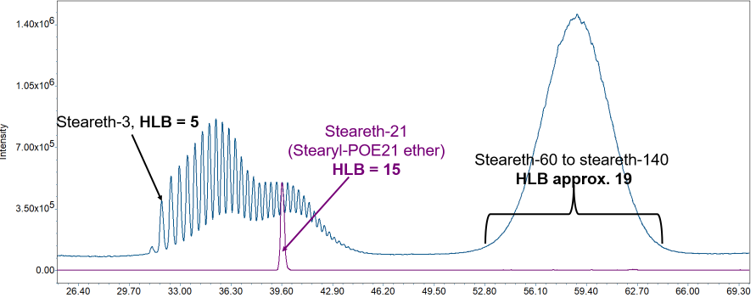
We have identified such (unexpected) complexity for a variety of excipients typically used in topicals. For details, see our presentation on Excipient Analytics & Reverse Engineering.
An excipient of know complexity is polysorbate 20. In a fusion of UPLC-MS analytics and stochastic modelling, we identified more than 20 000 components contained in this material. For more details, including variability between suppliers, see our publication (1).
For most generic development projects, the exact quantitative composition of the excipients is unknown. It must be determined through reverse engineering. Typically, both the FDA and the EMA require a precision of ±5% compared to the originator.
However, especially in topical semi-solids, complex excipients are frequently present. These are often mixtures of ten or more components that can vary between suppliers and sometimes between batches. Examples of complex excipients include surfactants, emulsifiers, mono-, di-, and triglycerides, and petrolatum (2, 3).
Analyzing such excipients cannot rely on a single component because the ratio between components can vary, which would lead to imprecise Q2 results. Furthermore, qualitative differences between suppliers can be significant. This means that even if the Q2 result is correct, using the wrong supplier may make Q3 and IVRT/IVPT equivalence impossible.
RaDes has developed innovative analytical methods that allow for exact quantification and qualitative fingerprinting. Often, this enables identification of the supplier. These methods de-risk and speed up generic development projects. This is especially important since authorities typically confirm Q2 sameness only after the complete dossier is submitted.
Better hypotheses and a more targeted approach make it possible to gain more insights with fewer experiments, saving both time and money.
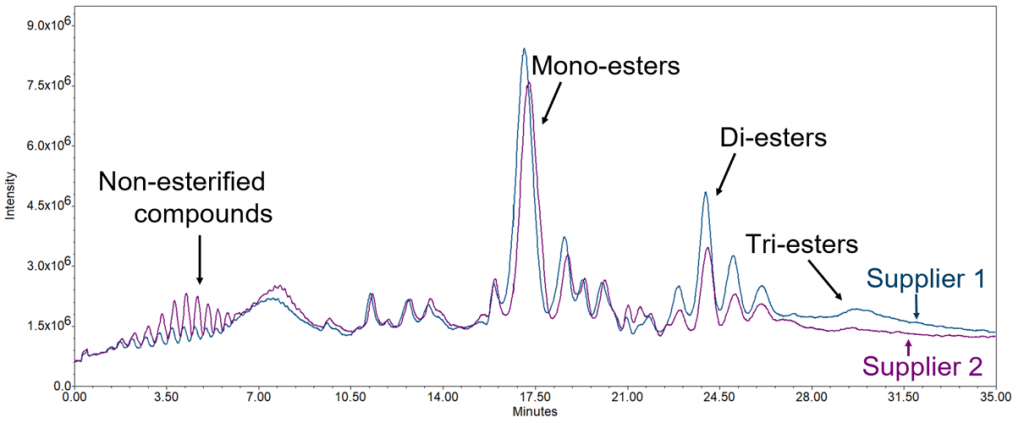
Examples of qualitative difference between pharmacopeial grades of polysorbate 20 from two different suppliers.
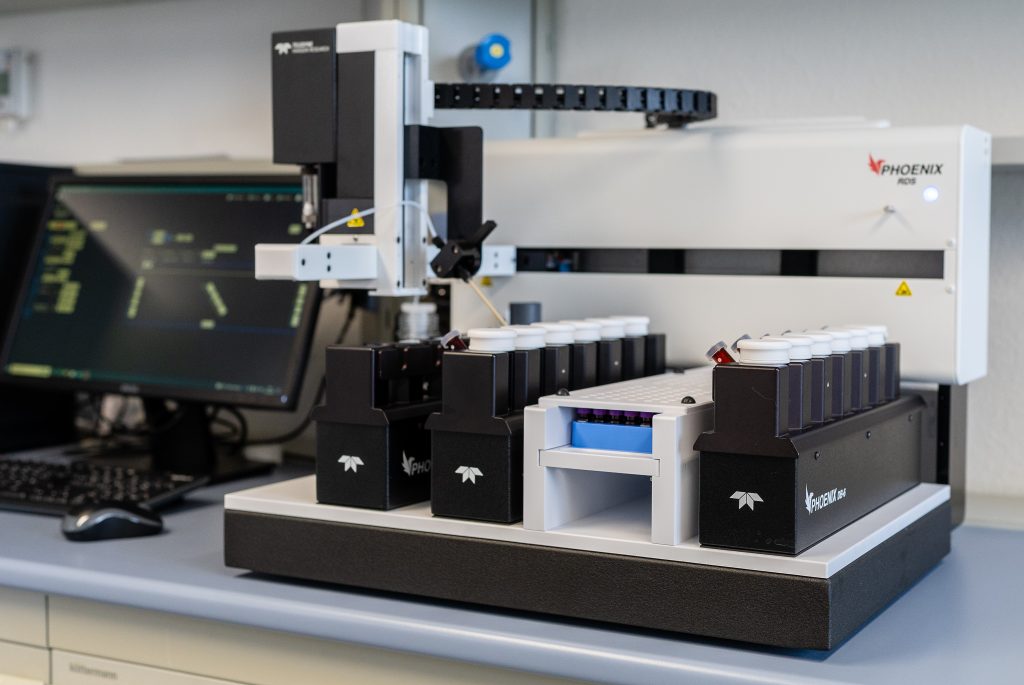
Once the Q2 assessment is complete, sameness in microstructure, arrangement of matter, or pharmaceutical equivalence must be demonstrated. This always includes a comprehensive rheological evaluation, which requires an absolute high-performance rheometer and experience in rheological testing. We offer both. We provide in vitro release testing services, including development analytical methods and receptor composition, membrane selection, validation, and pivotal equivalence studies, as well as the conception and manufacturing of modified formulations. IVRT and IVPT are run on modern, fully automated robotic diffusion stations that can operate 24 cells in parallel. Advanced stirring options and precise temperature control enable superior data quality compared to traditional systems. Additionally, we can determine pH, microscopic appearance, and globule size distribution if this is needed for Q3 characterization.
In many cases, IVPT using human skin is requested for the final demonstration of equivalence. RaDes provides the instrumentation and analytical capabilities necessary to conduct these studies according to highest FDA and EMA standards.
For more information on our in vitro models see https://rades-development.com/en/services/performance-testing/
We rely on state-of-the-art equipment, such as Waters UPLC systems with UV/VIS and MS detectors, HPLC and GC instruments from Agilent, as well as the Phoenix robotic diffusion station for IVRT and IVPT.
For more information on our labs and instruments see: https://rades-development.com/en/about-rades/our-labs/
References:
- Evers DH, Giebel J, Nienau F, Carle S, Gorissen S, Buske J, Herbig ME, Garidel P, Hagelskamp E, Unravelling the polysorbate 20 composition: A fusion of UPLC-MS analysis and stochastic modelling, Eur J Pharm Biopharm (216), 114854, 2025
- Herbig, M.E.; Evers, D.-H.; Gorissen, S.; Köllmer, M. Rational Design of Topical Semi-Solid Dosage Forms-How Far Are We? Pharmaceutics 2023, 15, 1822. https://doi.org/10.3390/pharmaceutics15071822
- Schoenfelder H, Reuter M, Evers D, Herbig ME, Lunter DJ, Ceramide Profiling of Porcine Skin and Systematic Investigation of the Impact of Sorbitan Esters (SEs) on the Barrier Function of the Skin. Molecular Pharmaceutics, 22 (4), 2019-2028, 2025

Sascha Gorissen, Co-Founder & Head of Laboratory
sascha.gorissen@rades-development.com